In the interconnection architecture of electronic devices, connectors perform the basic functions of signal transmission and power distribution. Based on what they connect, connectors can be divided into three fundamental types: wire-to-board connectors, board-to-board connectors, and wire-to-wire connectors. Understanding the differences among them and their respective technical priorities helps in making more informed decisions during the design phase.
1. Wire-to-Board Connectors: The Bridge Between Cables and PCBs
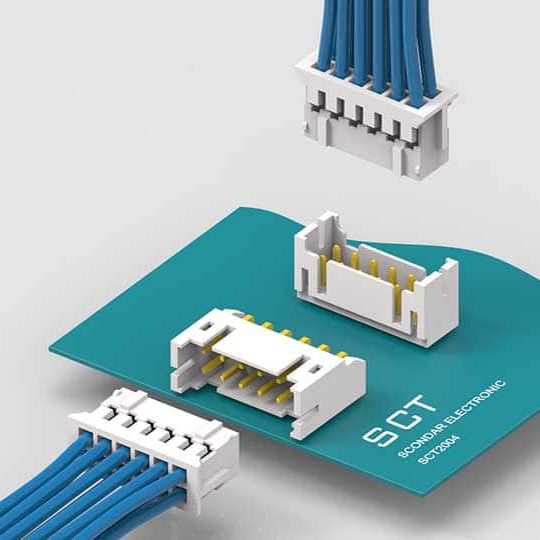
What is a wire-to-board connector?
A wire-to-board connector’s task is to connect a wire or wire harness to a printed circuit board (PCB). One end forms a permanent connection to the wire through processes such as crimping or insulation displacement, while the other end provides a separable interface with the board via pins and sockets. This is one of the most widely used connector types in electronics.
Key Characteristics and Parameters
Selection for wire-to-board connectors typically revolves around four dimensions:
-
Pitch: Determines the physical size and pin density of the connector. Signal-level products commonly range from 0.8 mm to 1.25 mm, while power-level products can span 3.96 mm to 7.92 mm.
-
Rated Current and Voltage: Must match the actual load. Signal-level ratings are typically below 1 A, while power-level ratings can reach 34 A or higher.
-
Locking Mechanism: Directly affects resistance to vibration and accidental disconnection. Common types include friction locks, positive locks, and dual locks with Terminal Position Assurance (TPA).
-
Termination Method: Crimping is the most prevalent technique, with crimp height and pull-out force directly related to connection quality. IDC (Insulation Displacement Connection) eliminates the stripping step and is suitable for rapid mass assembly.
Typical Applications
| Industry Sector | Example Equipment | Common Pitch Range |
|---|---|---|
| Consumer Electronics | Air conditioner control boards, washing machine PCBs | 1.0 mm – 2.5 mm |
| Automotive Electronics | Onboard modules, LED headlights | 1.2 mm – 3.0 mm |
| Industrial Automation | Sensors, servo drives | 2.0 mm – 5.08 mm |
| Smart Home | Smart locks, security cameras | 0.8 mm – 1.5 mm |
2. Board-to-Board Connectors: The Backbone of Modular Design
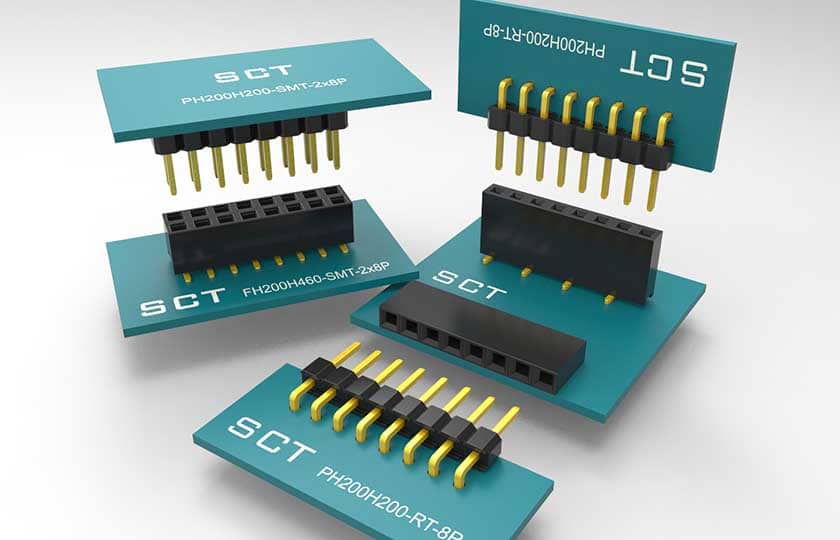
What is a board-to-board connector?
A board-to-board connector directly connects two PCBs without going through a wire intermediary. It saves wiring space and shortens signal paths, making it a key component in modular design. Common configurations include parallel stacking (mezzanine), perpendicular, co-planar edge-to-edge, and backplane architectures.
Key Characteristics and Parameters
-
Pitch and Stack Height: Modern board-to-board connector pitches have shrunk from 2.54 mm to as fine as 0.8 mm or 0.5 mm to support high-density layouts. Stack heights can be as low as 1.4 mm.
-
Impedance Matching and Shielding: In high-speed signal scenarios, the connector itself needs to offer good impedance control and electromagnetic shielding.
-
Assembly Compatibility: The presence of a vacuum pickup area and whether the connector is supplied in tape-and-reel packaging for fully automated placement can directly impact mass production efficiency.
Typical Applications
-
Daughter-card to motherboard connections (e.g., industrial computers, servers)
-
Internal connections between LCD panels and control boards
-
Stackable modular power supplies
-
Communication backplane systems
3. Wire-to-Wire Connectors: The Bond Between Individual Conductors
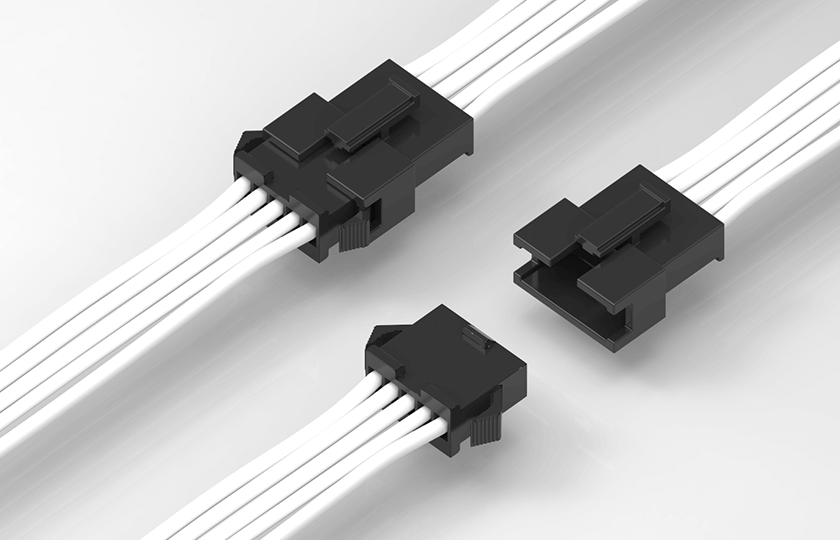
What is a wire-to-wire connector?
A wire-to-wire connector is used to join two wires together. It is commonly found where harness sections are mated, where circuits are extended, or where wires pass through a panel cutout to connect internal and external cabling. Because these connectors face direct exposure to real-world conditions, they often require greater environmental resilience than the other two types.
Key Characteristics and Parameters
-
Sealing and Protection: Rubber seals or potting processes can achieve IPX7 or higher protection ratings, making them suitable for wet or dusty environments.
-
Enhanced Locking Design: Built-in latches, secondary locks, and cavity-lock features prevent terminal back-out or partial mating.
-
Mounting Style: Available as free-hanging or panel-mount types to suit different routing paths and fixing methods.
Typical Applications
| Industry Sector | Example Equipment | Key Requirements |
|---|---|---|
| Automotive Wiring | Door harnesses, chassis sensor harnesses | Waterproof, vibration-resistant, wide temperature range |
| Renewable Energy | PV inverters, battery energy storage connections | High voltage, weather resistance |
| Motorcycles | Main vehicle harness | Anti-loosening, standardized interfaces |
| Industrial Equipment | Outdoor luminaires, power tools | IP protection, durability |
4. How to Choose a Connector Type Based on Your Requirements?
The following logic can be used step by step during actual selection:
-
Identify the Interconnection Target: Is it wire-to-PCB, PCB-to-PCB, or wire-to-wire? This determines the most basic type classification.
-
Confirm Electrical Requirements: Operating voltage, rated current, signal frequency, and whether impedance control or shielding is necessary.
-
Assess Mechanical Constraints: Available space, stack height, insertion and withdrawal force requirements, and whether a locking feature is needed to prevent disengagement.
-
Analyze Environmental Conditions: Temperature range, humidity, chemical exposure risk, vibration levels, and required water or dust ingress protection rating.
-
Consider Manufacturing Processes: Whether the product is compatible with wave soldering or reflow soldering, whether crimping or IDC is more suitable for termination, and whether automated assembly is needed.
It is worth noting that a complete interconnection solution does not consist solely of the connector housing and terminals themselves. It also involves cutting, crimping, assembling, bundling, and testing wire harness assemblies. In practice, evaluating connector selection together with wire harness manufacturing capability helps reduce compatibility issues and hidden costs in quality control handoffs.
*This article was prepared by the Scondar engineering team. Scondar specializes in custom wire harness and cable assembly manufacturing, and also supplies wire-to-board, board-to-board, and wire-to-wire connectors covering full pitches from 0.8 mm to 7.92 mm, compatible with JST, TE, Hirose, and other major brands. For questions about specific models or technical parameters, welcome to contact us*